
선박평형수처리장치 형식승인시험을 위한 시험생물에 관한 연구
초록
본 연구는 국제해사기구(IMO) 및 미국 해안경비대(USCG) 형식승인시험에 요구되는 시험생물 확보를 위해, 세 종류의 여과 농축 장치를 단독 및 조합하여 총 네 가지 조건(플랑크톤 네트(PN), 드럼필터(DF), 특허 농축기(ECPC), 드럼필터와 특허 농축기 연계 방식(DF+ECPC))으로 성능을 비교 평가하였다. 여과 농축 장치는 2023년 7월부터 12월까지 경남 자란만 해역에서 자연해수를 활용하여 평가되었으며, 모든 장치는 동일한 25 μm 필터를 사용하고 3회 반복 측정하였다. 회수율은 IMO 및 USCG에서 규정한 두 가지 크기의 생물군(≥10 μm and <50 μm, ≥50 μm)을 기준으로 분석하였다. 분석 결과, ECPC가 두 생물군 모두에서 가장 높은 회수율(≥10 μm and <50 μm: 75.0%, ≥50 μm: 59.1%)을 보였으며, PN이 가장 낮은 효율을 나타냈다. 생존율 분석에서는 PN의 ≥10 μm and <50 μm 생물군에서 재성장(regrowth)이 관찰되었고, ≥50 μm 생물군에서는 모든 장치에서 시간이 지남에 따라 생존율이 감소하였다. 이러한 장치 간 및 시간 경과에 따른 생존율 차이는 반복측정 분산분석 결과 유의하게 나타났다(p < .05). 종 조성은 모든 장치에서 안정적으로 유지되었으며, 백분율 유사성 지수(PSC)는 ≥10 μm and <50 μm 생물군에서 평균 79.6±7.1%, ≥50 μm 생물군에서는 평균 90.0±5.3%로, 특히 <50 μm 생물군에서 매우 유사한 군집 구조를 보였다. 이러한 결과를 통해서 ECPC는 시험생물확보를 위한 농축 효율성이 가장 우수했으며, 생물학적 활력 유지 측면에서는 PN이 상대적으로 유리하였다. 따라서 장치 간의 복합 운용은 생물 농축 효율성과 생태학적 대표성을 동시에 확보할 수 있는 실용적 방안으로 제시될 수 있으며, 본 연구 결과는 IMO 및 USCG 기준을 충족하는 시험생물 공급체계 정립에 기여할 수 있을 것으로 기대된다.
Abstract
This study compared and evaluated the performance of three filtration and concentration devices, individually and in combination, under four distinct conditions required for the International Maritime Organization (IMO) and United States Coast Guard (USCG) type approval testing for ballast water management systems. The tested conditions included a plankton net (PN), drum filter (DF), patented plankton concentrator (ECPC), and a combination of drum filter and patented plankton concentrator (DF+ECPC). All devices were assessed using natural seawater collected from Jaran Bay, Gyeongsangnam-do, South Korea, between July and December 2023, employing identical 25 μm filters in triplicate measurements. The recovery efficiency was analyzed based on two size classes specified by IMO and USCG standards (≥10 μm and <50 μm, ≥50 μm). Results showed that ECPC achieved the highest recovery rates for both size classes (≥10 μm and <50 μm: 75.0%, ≥50 μm: 59.1%), while PN exhibited the lowest efficiency. Survival analysis revealed regrowth in the ≥10 μm and <50 μm size class from the PN group, whereas survival rates in the ≥50 μm size class generally decreased over time across all devices. Significant differences among devices and over time were confirmed by repeated measures ANOVA (p < .05). Species composition remained stable across all devices, with the percentage similarity coefficient (PSC) averaging 79.6±7.1% for the ≥10 μm and <50 μm size class and 90.0±5.3% for the ≥50 μm size class, indicating particularly high similarity in the smaller size class (<50 μm). Consequently, ECPC demonstrated superior efficiency for concentrating organisms required for testing purposes, whereas PN showed advantages in maintaining biological viability. Combining multiple devices may provide a practical solution to simultaneously optimize concentration efficiency and ecological representativeness. The outcomes of this study are expected to contribute to the establishment of organism supply protocols meeting IMO and USCG standards.
Keywords:
Ballast Water Treatment System, Type Approval Test, Test Organisms, Filtration and Concentration Devices, Biological Efficacy Test키워드:
선박평형수처리장치, 형식승인시험, 시험생물, 여과 농축 장치, 생물학적 효력시험1. 서 론
선박의 평형수는 항해 중 선박의 안정성을 유지하기 위한 필수 시스템이지만, 이를 통해 다양한 지역에서 유입된 해양생물이 새로운 해역에 방출됨으로써 외래종 침입의 주요 통로로 작용한다. 이러한 생물학적 침입은 해양 생태계를 교란하고, 어업, 관광, 수산업 등 다양한 분야에 경제적 피해를 유발하는 것으로 알려져 있다(Drake and Lodge[2004]).
이 같은 문제에 대응하여 국제해사기구(IMO)는 2004년 선박평형수 및 퇴적물의 통제 및 관리에 관한 국제협약(BWM Convention)을 채택하고, 선박에서 배출되는 평형수에 포함된 생물의 밀도와 크기를 엄격히 규제하고 있다. 이후 IMO는 Ballast Water Management System Code(MEPC.300(72))를 제정하여 형식승인시험 절차를 표준화하였다. 또한 미국 환경보호청(USEPA)과 해안경비대(USCG)는 독자적인 형식승인 체계를 마련하여 ETV Protocol(USEPA[2010])을 통해 시험 방법과 조건을 제시하고 있다.
형식승인시험 중에서도 생물학적 효력시험(Biological Efficacy Test)은 장치의 실질적 유효성을 평가하는 핵심 시험으로, 일정 밀도와 다양성(5종 3문 이상)을 가진 살아있는 자연 플랑크톤을 ‘challenge water’로 확보해야 한다(IMO[2018]; USEPA[2010]). 구체적으로는 ≥50 μm 생물군은 105 organisms/m3 이상, ≥10 μm and <50 μm 생물군은 103 organisms/mL 이상의 밀도가 요구되며, 시험에 필요한 수량은 최소 250 m3 이상이다.
우리나라 연안에서는 계절적, 지리적 요인에 따라 플랑크톤의 밀도 및 출현 종이 급격하게 변동하며(Lee et al.[2001]; Sun et al.[2022]), 시험 조건에 부합하는 플랑크톤을 안정적으로 확보하기 어려운 실정이다. 따라서 시험생물을 효과적으로 농축할 수 있는 시스템의 도입이 필수적이다.
플랑크톤 농축 방법으로는 물리적(여과, 부상, 원심분리 등) 및 화학적(응집 침전) 방법이 존재하지만, 형식승인시험 요구 조건 충족에는 여과 방식이 가장 실용적이라는 평가가 다수의 연구를 통해 제시되어 왔다(Lemieux et al.[2010]). 플랑크톤 네트는 가장 일반적으로 사용되는 장치이나, 농축 과정에서 종의 손실과 기계적 자극에 따른 생존율 저하 가능성이 보고되었으며(Jang et al.[2020]), 농축 이후 장시간 저장 시 생물 활력 저하 문제가 발생하는 것으로 나타났다(Burkholder et al.[2007]; Casas-Monroy et al.[2020]).
본 연구에서는 국제 기준에 부합하는 시험생물 확보 방안을 제시하기 위해, 세 종류의 여과 농축 장치(플랑크톤 네트, 드럼필터, 특허 농축기)를 단독 및 조합하여 총 네 가지 조건(플랑크톤 네트, 드럼필터, 특허 농축기, 드럼필터와 특허 농축기 연계 방식)으로 설정하고, 각 조건의 회수율, 생존율 및 종 조성 성능을 비교·분석하였다. 나아가 각 장치의 성능 특성과 상호보완 가능성을 기반으로, BWMS 형식승인시험의 실용성과 생태학적 대표성을 동시에 만족하는 시험생물 공급 체계의 정립을 목적으로 한다.
2. 재료 및 방법
2.1 여과 농축 장치
본 연구에서는 세 종류의 여과 농축 장치를 이용하여 시험생물을 채집하였다. 사용된 장치는 플랑크톤 네트(Plankton net, 이하 PN), 드럼필터(Drum Filter, 이하 DF), 그리고 특허 등록된 농축기(Enhanced Concentrator for Plankton Capture, ECPC, 특허 제10-2196997호)이다. DF+ECPC는 두 장비를 연결한 장비다. 모든 장치는 동일한 여과망(25 μm, Polyethylene mono-filter, SAATI)을 사용하였으며, 각 장치의 구조는 다음과 같다. PN은 직경 300 mm, 길이 500 mm, DF는 직경 1,200 mm, 길이 2,000 mm(D1200, Ecofishvill), ECPC는 직경 300 mm, 길이 1,000 mm로 구성되어 있으며, ECPC는 실험 목적에 맞추어 자체 제작되었다(Fig. 1).
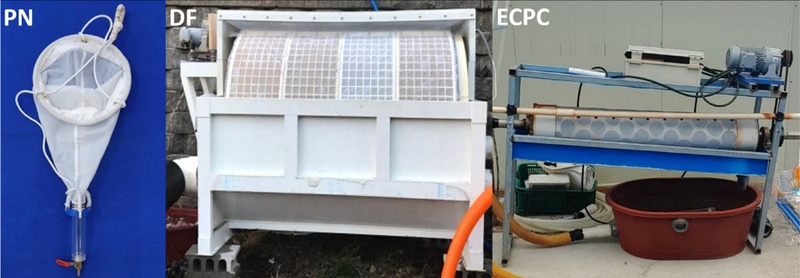
Photographs of the filtration and concentration devices used in this study.
2.2 시험생물 채집
모든 실험은 2023년 7월부터 12월까지 경상남도 자란만 해역에서 수행되었으며, 시험수는 해안가에 설치된 20마력 펌프를 이용하여 육상으로 이송하였다. 펌프에 연결된 직경 200 mm의 본관에서 50 mm 분기관으로 분지하여 세 장치에 동시에 유입되도록 설계하였다. 유량은 교정된 유량계를 이용하여 실시간 측정하였으며, 각 장치에 동일한 유입 조건이 유지되도록 유량과 시간을 통제하였다.
2.3 분석 방법
살아있는 시험생물의 밀도 분석은 형식승인시험에 규정된 시험 규격에 따라 진행하였으며, 각각의 여과 농축 장치를 통하여 농축된 시험생물은 6시간 이내에 현미경으로 관찰하였다(USEPA[2010]).
동물플랑크톤은 시료(5 mL)를 실체현미경(Olympus SZ51, magnification 10~40×)으로 먼저 죽은 개체를 계수한 후, 고정액(Lugol’s solution)을 사용하여 모두 사멸시킨 뒤 전체 개체 수를 계수하였다. 전체 개체 수에서 죽은 개체 수를 빼어 살아있는 개체 수를 계산하였다. 이때 죽은 개체의 판별은 현미경 관찰 시 움직임으로 판단하였으며, 움직이지 않는 개체는 자극하여 10초 동안 움직임이 없으면 죽은 것으로 판별하였다.
식물플랑크톤은 형광현미경(Olympus CX43, exciter BP 480/40; dichroic FT 505; barrier BP 530/30)을 사용하여 시료에 FDA와 CMFDA를 첨가한 후, 형광을 관찰하여 분석하고 계수하였다(Drake et al.[2011]).
시험생물의 회수율(Recovery, %)은 장치를 통해 농축된 시료 내의 생물량을 유입수의 생물량과 비교하여 다음 식으로 계산하였다. 모든 여과 농축 장치에 대해 3회 반복 측정(n=3)을 실시하였으며, 평균값과 표준편차를 산출하였다.
| (1) |
여기서 IP = 유입수의 생물 밀도
IC = 유입 총 수량
CP = 농축된 시료의 생물 밀도
CC = 농축된 시료의 총 수량
각 여과 농축 장치로부터 확보된 시험생물의 생존율(Survival, %)은 여과 직후부터 5일간 24시간 간격으로 측정하였다. 시료는 10 L씩 나누어 20 L 폴리프로필렌 샘플병에 보관하였으며, 수온은 자연해수 온도(24.5 ± 0.3℃)와 동일하게 유지하였다. 또한 14시간 명기, 10시간 암기의 광주기 조건을 설정하고 에어레이션을 지속적으로 공급하였다. 생존율은 다음의 식을 이용하여 계산하였다.
| (2) |
여기서 Nt= 특정 일자(t)의 생존 개체수
Ni= 초기 개체수
시험생물계수는 균질화한 시료를 3회 반복하여 수행하였다. ≥10 μm and <50 μm 생물군을 계수하기 위해, 유입수는 1 L를 여과 농축하여 최종 1 mL을 관찰하였고, 여과 농축 장치를 통과한 농축 시료는 추가 농축 없이 1 mL를 계수하였다. >50 μm의 생물군은 유입수 1 L를 여과 농축한 시료 10 mL와 여과 농축 장치를 통과한 농축시료 10 mL을 각각 계수한 후 환산하였다.
각 여과 농축 장치에서 확보된 시료 내 생물 군집 간 유사성을 평가하기 위해 종 조성(species composition)과 분류군(taxonomic group) 수준에서 분석을 수행하였다. 채집된 시료는 각 장치를 통해 농축한 후 광학현미경(SZ61, Olympus)을 이용하여 국내외 동물플랑크톤 도감을 기준으로 종 단위로 분류 및 동정하였다. 종 조성 간의 유사성은 백분율 유사성 계수(Percentage Similarity Coefficient, PSC)를 사용하여 정량적으로 평가하였다(USEPA[2010]). PSC는 서로 다른 두 장치 간에 관찰된 각 종의 상대적 비율(relative abundance)을 비교하여 계산하였으며, 계산식은 다음과 같다.
| (3) |
여기서 a, b = 각각의 장치에서 관찰된 특정 종 또는 분류군의 상대적 비율
분석 과정에서는 각 장치에서 관찰된 종의 상대적 비율을 바탕으로 PSC를 계산하였으며, 각 장치 조합에 대한 PSC 평균값을 산출하여 장치 간 종 조성의 유사성을 비교·평가하였다.
2.4 통계 분석
모든 통계 분석은 SPSS 소프트웨어(PASW Statistics 18)를 사용하여 수행하였다. 회수율(Recovery)의 장치 간 차이는 일원분산분석(one-way ANOVA)으로 평가하였으며, 유의한 차이가 확인된 경우 Tukey의 사후검정(Tukey’s HSD test)을 통해 각 장치 간 차이를 추가적으로 비교하였다. 생존율(Survival)의 변화는 장치와 시간(일자)을 요인으로 설정한 반복측정 분산분석(repeated measures ANOVA)으로 분석하였으며, 본 분석을 통해 시간 경과에 따른 생존율의 변화, 장치별 생존율 차이, 그리고 두 요인 간의 상호작용 효과를 검토하였다. 모든 통계 분석 수행 전에는 정규성(normality)과 분산 동질성(homogeneity of variance)을 확인하였다. 통계적 유의성은 p < .05 수준에서 판단하였다.
3. 결과 및 고찰
선박평형수 처리장치(BWMS)의 성능 평가에서 시험생물의 회수율, 생존율, 그리고 종 조성의 안정성은 IMO와 USCG가 규정한 형식승인시험의 핵심 항목이다. IMO의 BWMS Code(MEPC.300(72)) 및 미국 해안경비대(USCG)의 ETV Protocol(USEPA[2010])에서는 시험생물의 밀도, 생존성, 생물학적 대표성 확보를 필수 조건으로 제시하여, 실험 결과의 과학적 신뢰성을 보장하고 있다(Gollasch et al.[2024]; Adraktas[2024]). 본 연구는 이러한 국제적 기준을 충족하는 실험 환경을 구축하여, 각 여과 농축 장치의 성능 차이를 정량적 및 정성적으로 비교·평가하였다.
3.1 회수율
시험생물 회수율(Recovery) 분석 결과, ECPC가 두 생물 크기군 모두에서 가장 높은 회수율을 나타냈다(≥10 μm and <50 μm: 평균 75.0%, ≥50 μm: 평균 59.1%). 반면, PN은 각각 평균 17.8%, 20.3%로 가장 낮은 성능을 보였다. DF와 DF+ECPC 연계장치는 중간 수준의 회수율을 나타냈으며(DF: 57.4%, 47.6%; DF+ECPC: 47.7%, 35.6%), 일원분산분석(one-way ANOVA) 결과 두 크기군 모두에서 장치 간 유의한 차이가 확인되었다(p < .01, Fig. 2).
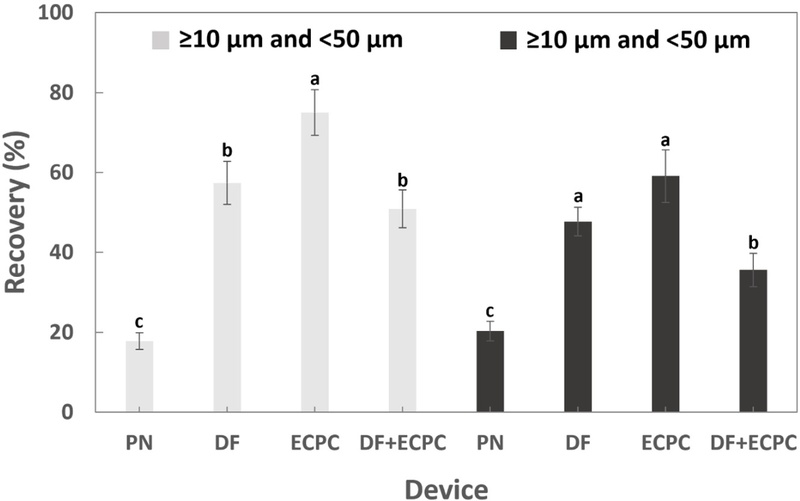
Comparison of recovery (%) for ≥10 μm and <50 μm, and ≥50 μm size classes among four different filtration and concentration devices based on one-way ANOVA. Significant differences in recovery rates were observed among devices for the ≥10 μm and <50 μm size group (F(3, 8) = 78.059, p < .001), as well as for the ≥50 μm size group (F(3, 8) = 40.702, p < .001). Different letters (a, b, c) above the bars indicate statistically significant differences between groups based on post-hoc comparisons (p < .05). Error bars represent standard deviations.
구체적으로, ≥10 μm and <50 μm 생물군의 회수율에서 장치 간 유의한 차이가 나타났다(F(3, 8) = 78.059, p < .001). Tukey 사후검정 결과 PN이 다른 장치들보다 유의하게 낮았으며(p < .05), ECPC는 가장 높은 회수율을 보였다(p < .05). DF와 DF+ECPC 간에는 유의한 차이가 없었으나(p = .375), DF와 ECPC(p = .009), ECPC와 DF+ECPC(p = .001)는 서로 유의하게 달랐다.
한편, ≥50 μm 생물군에서도 장치 간 회수율에 유의한 차이가 확인되었다(F(3, 8) = 40.702, p < .001). PN이 가장 낮은 값을 보였고(p < .05), DF와 ECPC 간 차이는 유의하지 않았다(p = .066). 그러나 DF와 DF+ECPC(p = .045), ECPC와 DF+ECPC(p = .001) 간에는 각각 유의한 차이를 나타냈다.
ECPC 장치의 높은 회수율은 고밀도 농축에 효과적인 드럼형 장치의 효율성에 대한 Veldhuis et al.[2006]의 연구 결과와 일치하였다. 반면, PN은 구조가 단순하고 비용 효율적인 장점에도 불구하고, 회수율이 낮아 실제로 높은 농도의 시험수를 요구하는 조건에서 단독 사용에 한계가 있음을 나타냈다. Stehouwer[2016]는 유사한 연구에서 단일 여과방식의 한계를 극복하기 위해 다단계 농축 방식이 필요하다고 제안한 바 있다. 본 연구에서의 DF+ECPC 연계 방식은 이와 같은 다단계 농축 접근법의 실용적인 사례로 평가될 수 있다.
3.2 생존율
≥10 μm and <50 μm 생물군을 대상으로 농축 후 5일간 생존율(Survival)을 반복측정 분산분석으로 평가한 결과, 시간(day)에 따른 주효과(F(2.040, 16.320) = 31.404, p < .001)와 장치(Group) 간 주효과(F(3, 8) = 13.335, p = .002, η2= .833)가 모두 유의하였다. 또한 시간과 장치 간의 상호작용(Day × Group) 효과 역시 유의하게 나타났다(F(6.120, 16.320) = 5.868, p = .002). 이는 측정 시점에 따라 생존율이 달라지고, 장치 간 평균 생존율에서도 차이가 있으며, 각 장치별 생존율 변화 양상이 시간이 지남에 따라 달라졌음을 의미한다.
장치 간 비교에서는 ECPC가 다른 그룹(PN, DF, DF+ECPC)보다 유의하게 낮은 평균 생존율(89.27%)을 보였으며(p < .05), PN, DF, DF+ECPC 간에는 통계적으로 유의한 차이가 없었다(p > .05). 시점별 생존율 변화를 살펴보면, 초기(1일 차, 평균 = 100%)부터 3일 차(평균 = 131.17%)까지 생존율이 유의하게 증가하였으며(p < .05), 이는 Casas-Monroy et al.[2016] 및 Liebich et al.[2012]의 연구에서 보고된 광 조건, 온도, 수질 유지 조건에 따른 회복능력(재성장, regrowth) 결과와 유사한 경향이다. 그러나 5일 차(평균 = 91.00%)에는 다시 감소하는 양상을 보였다.
특히 PN은 기계적 스트레스가 적어 3일 차까지 높은 생존율을 유지하였으며, 4일 차까지도 일정 수준의 생물 활력을 나타내었다(Fig. 3). 이는 PN이 생물학적 활력 유지에 유리한 조건을 제공했음을 시사한다.
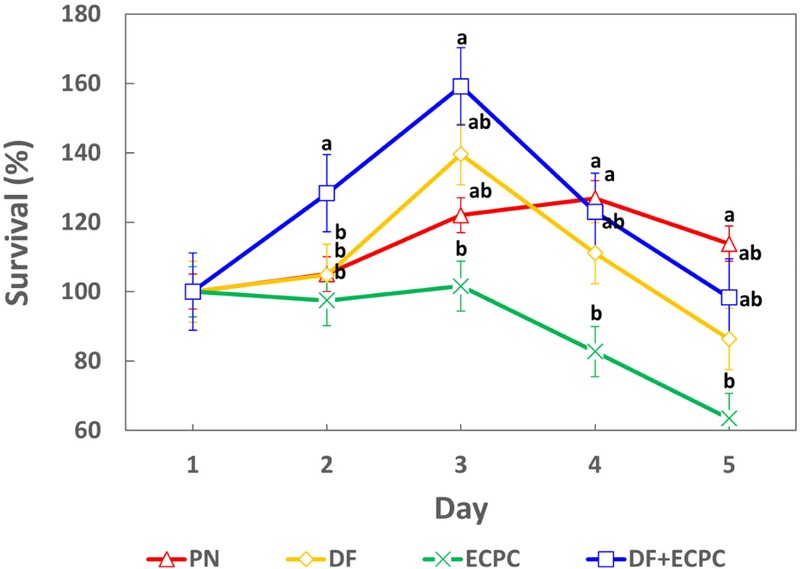
Changes in Survival (%) over 5 days for the ≥10 μm and <50 μm size class. Repeated measures ANOVA revealed significant differences in survival among device groups (F(3, 8) = 13.335, p = .002, η2 = .833). The ECPC group exhibited significantly lower survival compared to the other groups (p < .05). Different letters (a, b) indicate statistically significant differences among groups based on post-hoc comparisons (p < .05). Error bars represent standard errors.
한편, ≥50 μm 생물군의 생존율(Survival) 분석(Fig. 4)에서 반복측정 분산분석 결과, 시간(day)에 따른 주효과가 유의하게 나타났다(F(1.609, 12.871) = 352.112, p < .001, η2= .978). 실험 초기(1일차, 평균 = 100%) 이후 시간이 지남에 따라 생존율은 지속적으로 감소하여, 5일 차(평균 = 10.25%)에 가장 낮았다. 이는 Copepod 등 동물플랑크톤이 외부 기계적 충격과 수압 변화에 민감한 특성 때문으로 보이며, 실험 직후부터 생존율의 유의한 감소가 관찰된 결과와도 일치한다. 장치(Group) 간 주효과도 통계적으로 유의하게 나타났는데(F(3, 8) = 27.243, p < .001, η2= .911), 플랑크톤 네트(PN, 평균 = 61.93%)가 다른 장치인 DF(42.33%), ECPC(46.60%), DF+ECPC(44.67%)보다 유의하게 높은 생존율을 보였다(p < .05). 그러나 PN을 제외한 나머지 세 그룹 간에는 유의한 차이가 나타나지 않았다. 또한, Day × Group 간 상호작용 효과 역시 유의하게 나타났는데(F(4.827, 12.871) = 5.238, p = .008, η2= .663), PN은 2일차까지 상대적으로 높은 생존율을 유지한 반면, 나머지 세 그룹(DF, ECPC, DF+ECPC)은 보다 급격한 감소 추세를 보였다. 이는 Garćía-Garay and Franco-Herrera[2018]의 보고와 같이, 동물플랑크톤이 농축 과정에서 발생하는 기계적 처리에 급격히 민감하게 반응할 수 있음을 시사한다.
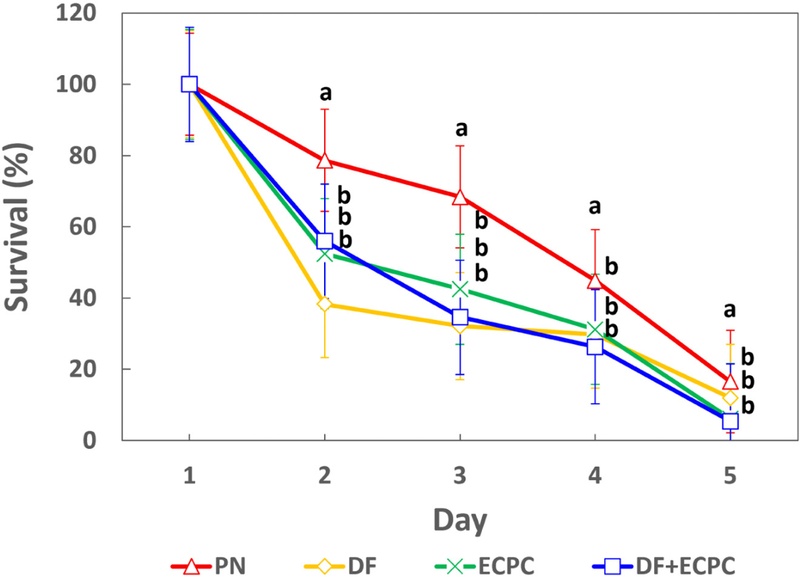
Changes in Survival (%) over 5 days for the ≥50 μm size class. Repeated measures ANOVA revealed significant differences in survival among device groups (F(3, 8) = 27.243, p < .001, η2 = .911). The PN group exhibited significantly higher survival than all other groups, while no significant differences were observed among DF, ECPC, and DF+ECPC groups. Different letters (a, b) indicate statistically significant differences based on post-hoc comparisons (p < .05). Error bars represent standard errors.
이상의 결과들은 BWMS 시험생물을 고농도로 공급할 때, 단순한 농축 효율뿐 아니라 생물의 활력 유지가 필수적임을 강조한다. 따라서 장치의 선정 및 설계 시 저유속, 무압 농축 등 생물학적 스트레스를 최소화하는 요소가 반드시 고려되어야 하며, Gollasch and David[2010]이 제안한 바와 같이 생존율을 보장하는 고밀도 농축 방식이 BWMS 성능평가의 시험생물 품질 관리에서 중요한 요소로 자리 잡아야 할 것이다.
3.3 종 조성 분석
본 연구에서는 각 여과 농축 장치가 생물 군집의 구성과 생물학적 대표성을 얼마나 보존하는지 평가하기 위해, 종 조성 분석과 함께 백분율 유사성 계수(Percentage Similarity Coefficient, PSC)를 산출하였다. 분석 결과, ≥10 μm and <50 μm 생물군의 장치 간 PSC 값은 평균 79.6±7.1%로 비교적 높은 유사도를 보였으며, 이 범주에서는 규조류 식물플랑크톤인 Chaetoceros spp.가 지속적으로 우점종으로 나타났다(Table 1, Fig. 5).

Relative species composition (%) and Percent Similarity Coefficient (PSC) of ≥10 μm and <50 μm phytoplankton collected using different filtration and concentration devices
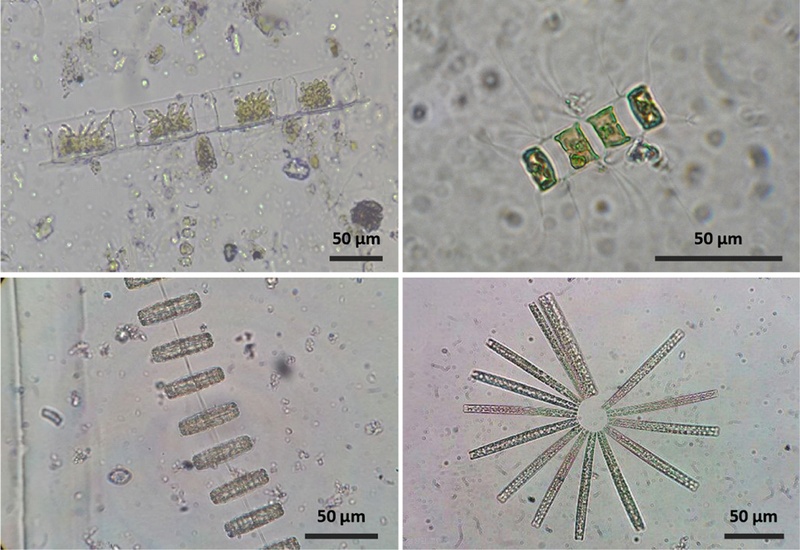
Dominant phytoplankton species in the ≥10 μm and <50 μm size class collected by filtration and concentration devices. The species shown from right to left are Chaetoceros spp., Lithodesmium spp., Thalassionema spp., and Thalassiosira spp. The scale bar represents 50 μm.
≥50 μm 생물군의 경우 Copepods가 지속적으로 우점하였으며, 부차적으로 Nauplii와 Polychaeta larva가 출현하였다(Table 2, Fig. 6). ≥50 μm 생물군에서의 평균 PSC 값은 90.0±5.3%로, EPA 기준에 따라 “매우 유사한 군집 구조”로 평가될 수 있다. 이는 두 생물크기군 모두에서 대표종 구성이 각 장치 간에 높은 일관성을 유지함을 의미하며, Adraktas[2024]가 강조한 바와 같이 BWMS 시험생물 선정 시 대표종의 일관성 유지가 중요하다는 견해와 일치한다.
Relative species composition (%) and Percent Similarity Coefficient (PSC) of ≥50 μm zooplankton collected using different filtration and concentration devices
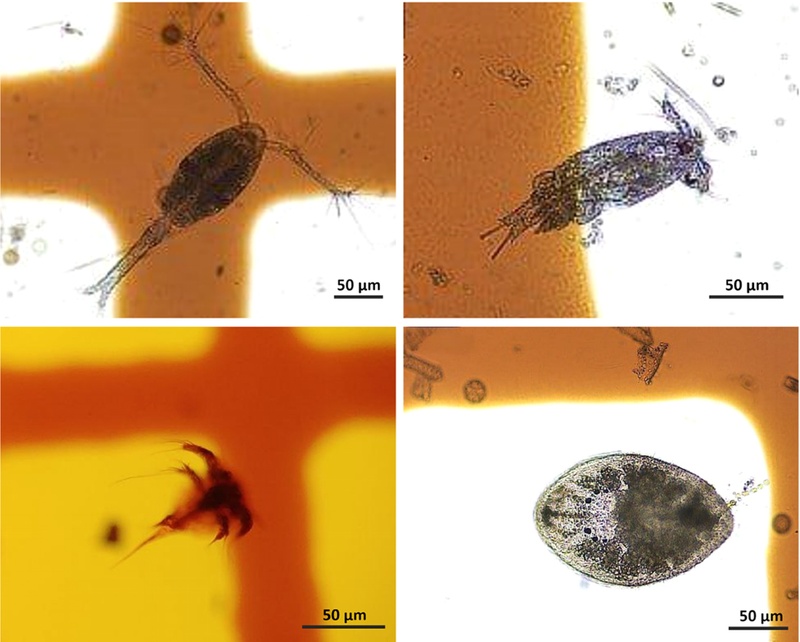
Dominant zooplankton species in the ≥50 μm size class concentrated by filtration and concentration devices. The images show representative copepods, nauplii, and a polychaete larva. The scale bar represents 50 μm.
이러한 결과는 본 연구에서 사용된 여과 농축 장치가 시험생물종 구성의 다양성을 유지하는 데 상대적으로 제한적인 영향을 미치며, 생물학적 효력 시험의 대표성을 확보하기 위한 구조적 적합성을 갖추고 있음을 시사한다. 향후 연구에서는 동물플랑크톤의 생존율 감소에 영향을 미치는 수온, 용존산소, 여과 유속 등의 복합적 환경요인을 정량적으로 분석하고, 여과 과정 중 발생할 수 있는 생물의 생리적 스트레스 반응을 분자생물학적 지표를 활용하여 평가하는 보다 체계적인 연구가 필요할 것으로 판단된다.
4. 결 론
본 연구는 제한된 실험 조건 하에서 BWMS 형식승인시험용 시험생물 확보 과정에서 여과 농축 장치의 성능 차이가 생물의 농축효율 및 생존성에 유의한 영향을 미칠 수 있음을 확인하였다. 실험 결과는 단순히 높은 회수율뿐만 아니라 생물학적 활력 유지 측면에서도 장치 선택의 중요성을 제시한다. 다만 본 연구의 결과는 특정한 실험 환경과 조건에서 도출된 것이므로, 이를 다양한 실제 운용 조건에 일반화하여 확대 해석하는 데는 신중할 필요가 있다. 향후 장치 설계 및 운용에서는 생물의 기계적 스트레스를 최소화하는 저유속·무압 조건 등 생물학적으로 친화적인 설계 요소를 보다 구체적이고 정량적으로 평가할 필요가 있다. 또한, 다양한 환경 조건과 보다 현실적인 현장 조건에서 다단계 농축 방식의 효과와 한계를 추가적으로 연구할 것을 제언한다.
Acknowledgments
본 연구는 2024년도 중소벤처기업부의 창업성장기술개발사업의 지원을 받아 수행되었습니다(과제번호 RS-2023-00278862, 휴대와 선박탑재가 가능한 국제항해 선박의 선박평형수 관리용 미세수중생물 생체 자가발광 스펙트럼 분석 장비개발).
References
- Adraktas, G., 2024, Ballast water treatment systems in vessels, Master's thesis, University of Piraeus, Piraeus, Greece.
-
Burkholder, J.M., Hallegraeff, G.M., Melia, G., Cohen, A., Bowers, H.A., Oldach, D.W., Parrow, M.W., Sullivan, M.J., Zimba, P.V., Allen, E.H., Kinder, C.A. and Mallin, M.A., 2007, Phytoplankton and bacterial assemblages in ballast water of U.S. military ships as a function of port of origin, voyage time, and ocean exchange practices, Harmful Algae, 6(4), 486-518.
[https://doi.org/10.1016/j.hal.2006.11.006]

-
Casas-Monroy, O., Chan, P.S. and Linley, R.D., 2016, Comparison of three techniques to evaluate the number of viable phytoplankton cells in ballast water after ultraviolet irradiation treatment, J. Appl. Phycol., 28(3), 1375-1384.
[https://doi.org/10.1007/s10811-016-0798-3]
-
Casas-Monroy, O., Rajakaruna, H. and Bailey, S.A., 2020, Improving estimation of phytoplankton abundance and distribution in ballast water discharges, J. Appl. Phycol., 32, 1185-1199.
[https://doi.org/10.1007/s10811-019-02034-x]
-
Drake, J.M. and Lodge, D.M., 2004, Global hot spots of biological invasions: evaluating options for ballast-water management, Proc. R. Soc. B Biol. Sci., 271(1539), 575-580.
[https://doi.org/10.1098/rspb.2003.2629]
- Drake, L.A., Lemieux, E.J., Robbins-Wamsley, S.H. et al., 2011, Validation of filter skids to capture viable organisms ≥50 μm for evaluating biological efficacy of ships’ ballast water management systems, NRL Letter Report 3900, 6130/1124, Washington, DC.
-
Garćía-Garay, J. and Franco-Herrera, A., 2018, Zooplankton sensitivity and phytoplankton regrowth for ballast water treatment with advanced oxidation processes, Environ. Sci. Pollut. Res., 25(14), 14016–14027.
[https://doi.org/10.1007/s11356-018-2308-4]
- Gollasch, S. and David, M., 2010, Testing sample representativeness of a ballast water discharge and developing methods for indicative analysis, Final Report, EMSA Tender N° EMSA/NEG/09/2010, 124.
-
Gollasch, S., David, M., van Slooten, C. and Peperzak, L., 2024, Type approval tests of ballast water management systems, what have we learned in >10 years testing, In Global Maritime Transport and Ballast Water Management, Invading Nature - Springer Series in Invasion Ecology, vol.16, Springer, Cham., 27-43.
[https://doi.org/10.1007/978-3-031-48193-2_2]
- International Maritime Organization (IMO), 2018, Code for approval of ballast water management systems (BWMS Code), MEPC.300(72), Retrieved from https://wwwcdn.imo.org/localresources/en/KnowledgeCentre/IndexofIMOResolutions/MEPCDocuments/MEPC.300(72).pdf, .
- Jang, P.G., Hyun, B.G., Lee, W.J. and Choi, K.H., 2020, Comparison of sampling method of phytoplankton for type approval of ballast water management system, JKAIS., 21(12), 426-433.
- Lee, J.H., Chae, J.H., Kim, W.R., Jung, S.W. and Kim, J.M., 2001, Seasonal variation of phytoplankton and zooplankton communities in the coastal waters off Tongyeong in Korea, Ocean Polar Res., 23, 233-245.
- Lemieux, E.J., Wier, T.P., Steinberg, M.K. et al., 2010, Design and preliminary use of a commercial filter skid to capture organisms ≥50 μm for evaluating ships’ ballast water management systems at land-based test facilities, NRL Letter Report 6130/1029, Washington, DC.
-
Liebich, V., Stehouwer, P.P.V. and Veldhuis, M., 2012, Re-growth of potential invasive phytoplankton following UV-based ballast water treatment, IMO GloBallast Monograph Series No. 22.
[https://doi.org/10.3391/ai.2012.7.1.004]
- Stehouwer, P.P.V., 2016, Effects of various ballast water treatment methods on the survival of phytoplankton and bacteria, Doctoral dissertation, University of Groningen.
-
Sun, Y., Youn, S.H., Oh, H.J., Joo, H.T., Kim, Y., Kang, J.J., Lee, D., Kim, K., Jang, H.K., Jo, N., Yun, M.S., Sun, L. and Lee, S.H., 2022, Spatial and temporal distribution of phytoplankton community in relation to environmental factors in the southern coastal waters of Korea, Front. Mar. Sci., 9, 950234.
[https://doi.org/10.3389/fmars.2022.950234]
- U.S. Environmental Protection Agency (USEPA), 2010, Environmental Technology Verification (ETV) Protocol for Ballast Water Treatment Technologies (Version 5.1), EPA/600/R-10/146, Washington, D.C., Retrieved from https://cfpub.epa.gov/si/si_public_record_report.cfm?Lab=NRMRL&dirEntryId=230926, .
-
Veldhuis, M.J., Fuhr, F., Boon, J.P. and Ten Hallers-Tjabbers, C.C., 2006, Treatment of ballast water; how to test a system with a modular concept?, Environ. Technol., 27(8), 909-921.
[https://doi.org/10.1080/09593332708618701]