
해양수질자동측정망 기반 자유용존상 잔류성유기오염물질의 연속 모니터링 가능성 평가

초록
화학 분석을 기반으로 한 잔류성유기오염물질의 위해성을 보다 정확하게 평가하기 위해서는 생물에 직접적으로 이용되는 자유용존상 농도를 파악하는 것이 중요하다. 본 연구에서는 부산 수영만 특별관리해역의 해양수질자동측정망에 고속회전식 수동형 채집기(high-speed rotation-type passive sampling device, HSR-PSD)를 도입하여 자유용존상 잔류성유기오염물질의 연속 모니터링 가능성을 평가하였다. 해수를 HSR-PSD에 연속 공급하며 600 rpm 조건에서 운전한 결과, 다환방향족탄화수소(polycyclic aromatic hydrocarbons, PAHs)와 폴리염화비페닐(polychlorinated biphenyls, PCBs)의 적정 가동 시간은 각각 3일과 14일로 나타났다. 2021년 7~8월 수영만에서 측정된 자유용존상 PAHs 및 PCBs 평균 농도는 각각 3.6±0.90 ng/L, 107±61 pg/L였다. 또한 강우 시기에 상대적으로 높은 농도가 관찰되었으며, 이는 HSR-PSD가 오염물질 유입에 따른 농도 변동을 반영할 수 있는 가능성을 시사한다. 따라서 기존 해양수질자동측정망에 HSR-PSD를 도입하여 장기 운용할 경우, 오염우심해역에서의 자유용존상 유기오염물질 자료를 지속적으로 확보하고 보다 신뢰성 있는 위해도 평가에 활용될 수 있을 것으로 기대된다.
Abstract
Accurate risk assessment of persistent organic pollutants (POPs) based on chemical analysis requires the determination of their freely dissolved concentrations that are directly bioavailable to organisms. In this study, a high-speed rotation-type passive sampling device (HSR-PSD) was introduced into the marine water quality aquatic monitoring network in Suyeong Bay, Busan, a designated special management area to evaluate the feasibility of continuous monitoring of freely dissolved POPs. Seawater passing through a sedimentation tank was continuously supplied to the HSR-PSD operated at 600 rpm. The optimal operating times required to reliably obtain the freely dissolved concentrations of polycyclic aromatic hydrocarbons (PAHs) and polychlorinated biphenyls (PCBs) were determined to be 3 and 14 days, respectively. During July to August 2021, the freely dissolved concentrations of PAHs and PCBs in Suyeong Bay ranged from 2.6 to 4.4 (mean 3.6±0.90) ng/L and 45 to 162 (107±61) pg/L, respectively. Relatively higher concentrations were observed during rainfall periods, suggesting that the HSR-PSD has the potential to reflect concentration variability associated with the inflow of pollutants. These results suggest that the application of HSR-PSD to a marine water quality automatic monitoring network is expected to enable the continuous accumulation of freely dissolved data on POPs in highly contaminated areas and to support more reliable risk assessments.
Keywords:
Polycyclic aromatic hydrocarbons, Polychlorinated biphenyls, Passive sampler, Polyethylene, Freely dissolved concentrations, Special management area키워드:
다환방향족탄화수소, 폴리염화비페닐, 수동형 채집기, 폴리에틸렌, 자유용존상 농도, 특별관리해역1. 서 론
잔류성유기오염물질(Persistent Organic Pollutants, POPs)은 화학적으로 안정한 구조를 가지며 환경 중에서 분해가 어려워 높은 잔류성과 생물농축성을 가진 유해물질이다(UNEP[2001]). 이들은 미량으로도 독성을 나타낼 수 있어, 스톡홀름 협약에 따라 30종 이상의 물질에 대해 생산 및 사용이 국제적으로 규제되고 있다(UNEP[2026]). 국내에서도 POPs의 오염실태 및 장기 변화 추세를 파악하고 오염원을 규명하기 위하여 2001년부터 해양생태계 내 잔류성유기오염물질 조사사업이 수행되고 있으며, 해양생태계와 수산생물 위해성 측면에서 지속적인 관리 필요성이 제기되고 있다(MOF[2019]).
해수 중 POPs는 입자(0.45 μm 이상)에 흡착된 입자상(particulated phase), 콜로이드 또는 용존유기탄소에 결합된 용존상(dissolved phase), 그리고 어떠한 물질과도 결합하지 않은 자유용존상(freely dissolved phase) 형태로 구분된다. 이 중 자유용존상 형태는 생물막을 직접 통과할 수 있어 해양생물에 대한 생물학적 이용도(bioavailability)를 결정하는 핵심 인자로 알려져 있다(ITRC[2011]; USEPA[2012]). 따라서 해양생물의 실제 노출 수준과 생태위해성을 평가하기 위해서는 자유용존상 POPs 자료의 확보가 중요하다(Di Toro et al.[1991]; Perron et al.[2013]).
수동형 채집기(passive sampler)는 환경 매체와 채집기 간의 분배평형 원리에 기반하여 자유용존상 오염물질만을 선택적으로 흡수할 수 있으며, 생물농축 예측 및 생태위해성 평가에 보다 정확한 자료를 제공한다(You et al.[2006]; Joyce et al.[2015]; Ortega-Calvo et al.[2015]). 그러나 기존 수동형 채집기는 평형에 도달하기까지 장시간이 소요되며, 현장 적용 시 생물부착으로 인한 흡수 속도 저하와 시료 유실 등의 문제로 인해 지속적인 자료 확보에 어려움이 있다(Cornelissen et al.[2008]; Apell et al.[2016]). 이러한 한계를 극복하기 위해, 본 연구팀은 수동형 채집기 주변에 난류를 형성하여 물질 전달 속도를 향상시킨 고속회전식 수동형 채집기(high-speed rotation-type passive sampling device, HSR-PSD)를 개발하였다(Jang et al.[2021b]). 또한 이를 국내 연안 및 외해에 적용하여 다양한 유기오염물질의 자유용존상 농도 자료를 구축한 바 있다(Jang et al.[2022]; Kim et al.[2020]; Oh et al.[2024]; Park et al.[2025]).
한편, 해양수산부는 전국 주요 하구역 및 특별관리해역에 22개 해양수질자동측정소를 운영하여 기상, 일반 수질 및 주요 영양염류에 대한 자료를 실시간으로 모니터링하고 있다(해양수산부 고시 제2022-20호). 각 측정소에는 무정전 전원공급장치, 자동시료채취기, 시료채취조 및 수질자동측정기기가 설치되어 있다(ME, 2023). 전력 공급과 지속적인 해수 취수는 HSR-PSD의 운용에 적합한 조건을 제공한다. 또한 장기 운용이 가능할 경우, 오염우심해역에서 자유용존상 POPs 자료를 지속적으로 축적하고 이를 기반으로 보다 정확한 생태위해성 평가가 가능할 것으로 기대된다.
따라서 본 연구에서는 HSR-PSD를 기존 해양수질자동측정망에 적용하여 자유용존상 POPs의 연속 모니터링 가능성을 평가하고자 하였다. 이를 위해 부산 연안 수영만에 위치한 해양수질자동측정소를 시험 대상으로 선정하였다. 수영만은 수영강과 하수처리장 방류수 등의 영향을 받는 반폐쇄성 해역으로, 다환방향족탄화수소(polycyclic aromatic hydrocarbons, PAHs)와 폴리염화비페닐(polychlorinated biphenyls, PCBs)과 같은 유기오염물질이 지속적으로 검출되어 왔다(Choi et al.[2011]; Han et al.[2016]; Lee et al.[2018]; Ok et al.[2011]). 본 연구에서는 실행보정물질(performance reference compounds, PRCs)을 이용하여 HSR-PSD의 최적 운전 조건을 도출하였고, 이를 기반으로 수영만에서의 자유용존상 PAHs 및 PCBs 농도를 모니터링하였다. 마지막으로 해양수질자동측정망 시스템에서 HSR-PSD의 장기 운용 가능성을 평가하고, 향후 지속적인 운영을 위한 적용 방안을 제시하였다.
2. 재료 및 방법
2.1 분석대상물질 및 표준물질
본 연구에서는 수영만에서 검출 빈도가 높은 PAHs와 PCBs를 분석대상물질로 선정하였다. 이들은 높은 잔류성, 생물축적성 및 독성을 가지는 대표적인 유기오염물질이며, 특히 PCBs는 스톡홀름 협약에 의해 생산 및 사용이 제한된 주요 POPs에 해당된다.
PAHs는 미국환경보호청(USEPA)에서 지정한 16종 우선관리대상물질(naphthalene, acenaphthylene, acenaphthene, fluorene, phenanthrene, anthracene, fluoranthene, pyrene, benz[a]anthracene, chrysene, benzo[b]fluoranthene, benzo[k]fluoranthene, benzo[a]pyrene, indeno[1,2,3-cd]pyrene, dibenz[a,h]anthracene, benzo[g,h,i]perylene)을 대상으로 하였다. PCBs는 염소 치환 수 2~7개의 22종 congeners(PCB 8, 18, 28, 29, 52, 44, 87, 101, 105, 110, 118, 128, 138, 153, 170, 180, 187, 194, 195, 200, 205, 206)를 분석하였다.
분석대상물질의 평형 도달 정도를 예측하고 비평형 조건에서의 자유용존상 농도를 보정하기 위해 PRCs를 사용하였다. PRCs는 환경 중에 존재하지 않으면서 분석대상물질과 유사한 물리·화학적 특성을 가져야 한다. 이에 PAHs의 경우 4종(fluorene-d10, fluoranthene-d10, benz[a]anthracene-d12, benzo[e]pyrene-d12)을 사용하였으며, PCBs용 PRCs로는 10종 congeners(PCB 10, 14, 21, 30, 50, 55, 78, 104, 155, 204)를 적용하였다.
실험 회수율을 평가하기 위해 사용한 내부표준물질(surrogate standards)은 PAHs 및 PCBs 각각 5종(naphthalene-d8, acenaphthene-d10, phenanthrene-d10, chrysene-d12, perylene-d12)과 2종(PCB103, PCB198)을 사용하였다.
본 연구에 사용된 분석대상물질, PRCs, 내부표준물질, 기체크로마토그래프용 내부표준물질(gas chromatograph internal standards)은 모두 AccuStandard(New Haven, CT, USA)에서 구매하였다.
2.2 해양수질자동측정망에서의 HSR-PSD 적용
HSR-PSD(제10-2439213호)는 스테인리스 재질의 원통형 배럴(60 L), 회전 모터, 프로펠러, 제어부 및 시트형 수동형 채집기 고정 프레임으로 구성된다(Fig. 1). 해수는 배럴 하부로 유입되어 상부로 배출되며, 시트형 수동형 채집기는 사각 프레임에 고정된 상태로 배럴 내부에 설치된다. 상부 모터와 직결된 프로펠러의 회전에 의해 배럴 내부 해수가 교반되면서 수동형 채집기 주변에 난류가 형성된다.
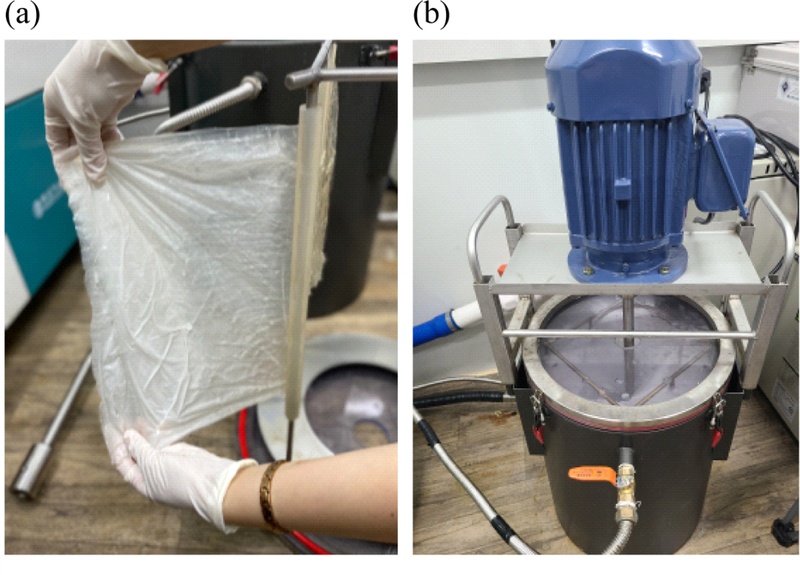
(a) Sheet-type LDPE used in the HSR-PSD and (b) installation of the HSR-PSD at the marine water quality automatic monitoring network in Suyeong Bay.
시트형 수동형 채집기로는 옥탄올-물 분배계수(octanol-water partition coefficient, logKOW)가 3~7 범위의 유기물질에 적합한 저밀도 폴리에틸렌(low-density polyethylene, LDPE)을 사용하였다(Fig. 1a). 두께 25.4 μm의 LDPE 시트(Covalence, Minneapolis, MN, USA)를 45×30 cm(약 3.5 g) 크기로 절단한 후, 디클로로메탄, 메탄올 및 초순수를 이용하여 각각 15분간 초음파 세척하여 불순물을 제거하였다(Lao et al.[2019]). 이후 메탄올:물(80:20, v/v) 혼합용매에 각 PRC를 최종 농도가 1 μg/L가 되도록 첨가한 후, 세척된 LDPE 시트를 7일간 침지하여 PRCs를 흡수시켰다(Booij et al.[2002]).
2021년 7월부터 8월까지 부산 수영만(35°09'54.0"N, 129°07'48.4"E)에 위치한 해양수질자동측정소에서 HSR-PSD를 설치 및 가동하였다(Fig. 1b). 시료채취조를 거친 해수는 20 L/min의 유량으로 HSR-PSD 하부로 유입되어 상부로 배출되도록 하였다. HSR-PSD에 PRCs를 사전 흡수시킨 LDPE 시트를 장착한 후 600 rpm 조건에서 3, 7, 14, 19일 동안 운전하였으며, 모터 과부하를 방지하기 위해 2시간마다 25분간 정지하도록 설정하였다. 각 노출 기간 종료 후 LDPE 시트를 회수하여 알루미늄 호일로 밀봉한 뒤 실험실로 운반하였다. 회수된 LDPE는 실험용 와이퍼로 표면의 이물질을 제거한 후 분석 전까지 –20℃에서 냉동 보관하였다.
2.3 전처리 및 기기 분석
LDPE 표면에 PAHs 및 PCBs 내부표준물질을 첨가한 후, 디클로로메탄 100 mL를 이용하여 15분간 3회 초음파 추출하였다(Fernandez et al.[2012]; Lao et al.[2019]). 추출액은 알루미나(1% 수분함량)/실리카겔(5% 수분함량) 컬럼으로 정제한 후, 회전식 증발농축기로 농축하고 헥산으로 용매 치환하여 기기분석 하였다. 시료는 기기분석 전까지 –20℃에서 보관하였으며, 분석 직전에 기체크로마토그래프용 내부표준물질을 첨가하였다.
PAHs 및 PCBs는 기체크로마토그래피-질량분석법(gas chromatography-mass spectrometry) (7890GC/5975MS, Agilent Technologies, USA)을 이용하여 정량 및 정성 분석하였다. 물질 분리를 위해 DB-5MS 모세관 컬럼(30 m × 0.25 mm i.d., 0.25 μm thickness, J&W Scientific)을 사용하였으며, PAHs 및 PCBs의 기기분석 조건은 각각 Table S1 및 Table S2에 제시하였다.
2.4 자료 처리
HSR-PSD 가동 전후 LDPE의 PRCs 농도를 이용하여 분석대상 물질의 평형 도달 정도(fractional equilibrium, feq)를 예측할 수 있다(Fernandez et al.[2012]; Sacks and Lohmann[2012])(식 (1)).
| (1) |
여기서 feq = 평형도달정도(fractional equilibrium)
= 수동형 채집기 내 초기 PRC 농도(ng/kg)
= 노출시간 t에서의 수동형 채집기 내 PRC 농도(ng/kg)
분석대상물질이 해수와 수동형 채집기 간 평형에 도달한 경우, 해수 내 자유용존상 농도는 수동형 채집기에 흡수된 농도와 수동형 채집기-물 분배계수로부터 산출하였다(식 (2)). 반면 평형에 도달하지 않은 경우, PRCs를 이용하여 자유용존상 농도를 보정 및 산출하였다(식 (3)~(5)). 이때 각 분석대상물질의 수동형 채집기-물 분배계수는 Lohmann[2012]의 자료를 이용하였으며, Le Bas 몰 부피 값은 Mackay et al.[2006]에서 제시된 값을 사용하였다.
| (2) |
| (3) |
| (4) |
| (5) |
여기서 CW = 분석대상물질의 자유용존상 농도(ng/L)
= 평형에 도달하였을 때 수동형 채집기 내 분석대상물질의 농도(ng/kg)
KPW = 수동형 채집기-물 분배계수(L/kg)
= 노출시간 t에서의 수동형 채집기 내 분석대상물질의 농도(ng/kg)
mp = 수동형 채집기의 질량(kg)
Rs = 분석대상물질의 흡수 속도(L/day)
RS,PRC = PRC의 용출 속도(L/day)
Vm = 분석대상물질의 Le Bas 몰 부피(cm3/mol)
Vm,PRC = PRC의 Le Bas 몰 부피(cm3/mol)
수동형 채집기-물 분배계수는 수온 및 염분의 영향을 받는다 (Lohmann[2012]). 따라서 식 (6)~(7)을 이용하여 현장 수온과 염분 조건으로 보정된 분석대상물질의 LDPE-물 분배계수를 산출하였다 (Table S3). 수온 및 염분 값은 HSR-PSD 가동 기간 동안 해양수질 자동측정망에서 측정된 평균값을 사용하였다(Table 1).
| (6) |
| (7) |
여기서 KPW,T = 수온 T(K)에서의 수동형 채집기-물 분배계수
KPW,298 = 수온 298 K에서의 수동형 채집기-물 분배계수
△HPW = LDPE와 물 사이 엔탈피 변화(-25 kJ/mol)
R = 기체상수(8.3143 J/mol/K)
KPW,salt = 특정 염분에서의 수동형 채집기-물 분배계수
KS = 염석 상수(0.35 M–1)
[salt] = 염의 몰 농도(M)

Operating period of HSR-PSD and mean temperature and salinity in Suyeong Bay for each survey (MEIS[2021])
2.5 정도관리
LDPE 분석 시, PAHs의 내부표준물질 회수율은 59~102%였으며, PCB는 88~92% 범위로 나타났다. 분석대상물질의 농도는 LDPE에서의 검출 농도에서 현장바탕시료에서의 값을 보정하여 산정하였다.
방법검출한계는 현장바탕시료에서 검출된 농도의 표준편차에 3을 곱하여 산정하였다. 그 결과, PAHs의 방법검출한계는 불검출(not detected, ND)~4.3 ng/g(acenaphthene)였으며, PCBs는 ND~4.1 ng/g(PCB101)이었다. 검출한계 미만의 자료에 대해서는 ND로 처리하였다.
3. 결과 및 고찰
3.1 HSR-PSD의 최적 가동 조건
HSR-PSD 가동 시간에 따른 PAHs 및 PCBs의 평형 도달 정도는 전반적으로 화합물의 소수성(logKOW)이 클수록 감소하는 경향을 보였으며, 동일 조건에서 가동 시간이 짧을수록 낮게 나타났다(Fig. 2). PAHs의 경우, 3일 가동 시 fluorene-d10(logKOW=4.2)와 fluoranthene-d10(logKOW=5.2)의 평형 도달 정도는 1로 평형에 도달한 것을 확인하였다(Fig. 2a). 반면, 상대적으로 소수성이 큰 benz[a]anthracene-d12(logKOW=5.9) 및 benzo[e]pyrene-d12(logKOW=6.4)는 약 0.4~0.6 수준을 보였다(Fig. 2a). PRCs는 초기 농도의 17% 이상 감소(평형 도달 정도 ≥0.17)할 경우 신뢰성 있는 보정이 가능한 것으로 알려져 있다(Apell and Gschwend[2014]; Booij and Smedes[2010]). 이를 고려할 때, PAHs는 3일간의 HSR-PSD 가동만으로도 PRCs를 이용한 자유용존상 농도 산출이 가능한 것으로 판단된다.
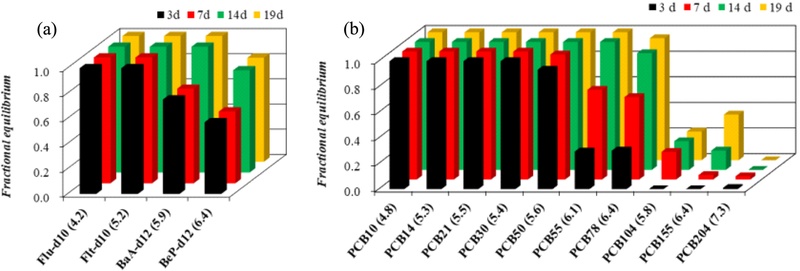
Fractional equilibrium of PRCs for (a) PAHs and (b) PCBs as a function of HSR-PSD operating time (3, 7, 14, and 19 days). Values in parentheses on the x-axis indicate the logKOW values corresponding to each PRC. Flu-d10=fluorene-d10; Flt-d10=fluoranthene-d10; BaA-d12=Benz[a]anthracene-d12; BeP-d12=benzo[e]pyrene-d12.
PCBs의 경우, logKOW=4.8~5.6 범위의 PCB congers(10, 14, 21, 30, 50)는 3일 가동만으로 평형에 도달하였다(Fig. 2b). logKOW=5.8~6.4 범위의 PCB congers(55, 78, 104, 155)는 가동 시간이 증가함에 따라 평형 도달 정도가 증가하였으며, 14일 가동 시에야 0.2 수준으로 안정적으로 검출되었다. 반면, 가장 소수성이 큰 PCB204(logOW=7.3)는 21일간 가동에도 0.1 이하로 낮게 유지되었다(Fig. 2b). 따라서 자유용존상 PCBs 산출을 위해서는 logKOW 6.4 이하 화합물에 대해 14일간의 가동이 필요한 것으로 판단된다. 동일한 logKOW 조건에서 PCBs의 평형 도달 정도가 PAHs보다 낮은 이유는 PCBs의 몰부피가 PAHs보다 커 수동형 채집기로 흡수되는 데 더 긴 시간이 소요되기 때문이다(Apell and Gschwend[2014]; Joyce et al.[2015]; Jang et al.[2021a]).
이론상으로 LDPE를 해수에 단순 노출할 경우, PAHs의 평형 도달 시간은 0.1일에서 174일까지 소요되는 것으로 보고되었다(Apell et al.[2016]). 또한 비평형 조건에서 PRCs를 이용하여 보정한 기존 연구에서도 수동형 채집기를 해수에 약 1~2개월간 노출하여 농도를 산출하였다(McDonough et al.[2018]; Cornelissen et al.[2008] and [2009]; Monteyne et al.[2013]). 따라서 본 연구 결과, HSR-PSD는 기존 수동형 채집기 대비 상대적으로 짧은 가동 시간으로 자유용존상 유기오염물질 자료를 확보할 수 있음을 확인하였다.
3.2 자유용존상 PAHs 및 PCBs 분포 특성
HSR-PSD를 통해 수영만에서 측정된 자유용존상 PAHs 농도는 2.6~4.4 ng/L 범위였으며, 평균 3.6±0.90 ng/L로 나타났다(Fig. 3a). HSR-PSD의 가동 시간이 증가함에 따라 검출된 PAHs는 8종에서 12종으로 증가하였다. 주요 검출 화합물은 logKOW<5.5인 acenaphthene(ACY), phenanthrene(PHE), anthracene(ANT), fluoranthene(FLT), pyrene(PYR)으로, 이들 화합물은 총 PAHs 농도의 95%를 차지하였다.
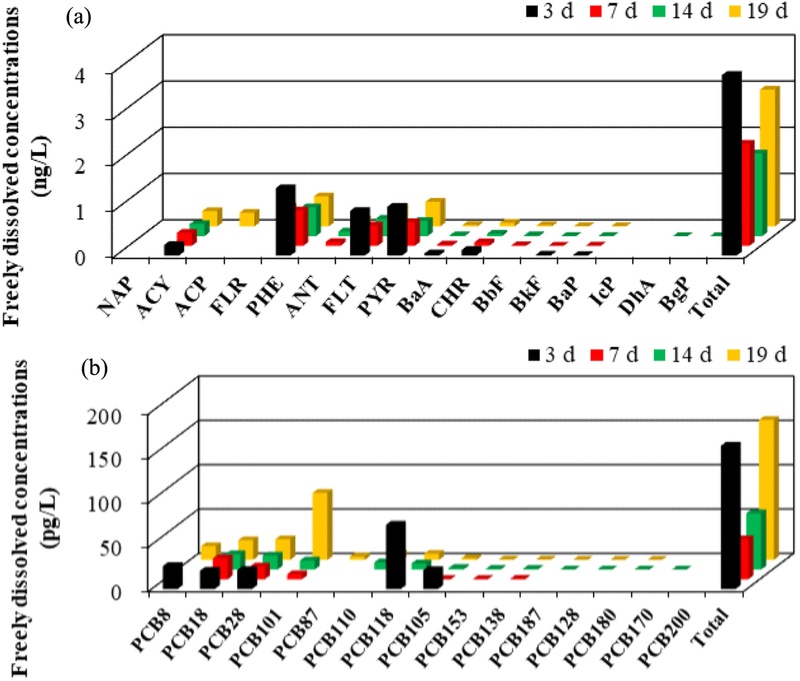
Freely dissolved concentrations of (a) PAHs (ng/L) and (b) PCBs (pg/L) in Suyeong Bay from July to August 2021. NAP=naphthalene; ACY=acenaphthylene; ACP=acenaphthene; FLR=fluorene; PHE=phenanthrene; ANT=anthracene; FLT=fluoranthene; PYR=pyrene; BaA=benz[a]anthracene; CHR=chrysene; BbF=benzo[b]fluoranthene; BkF=benzo[k]fluoranthene; BaP=benzo[a]pyrene; IcP=indeno[1,2,3-cd]pyrene; DhA=dibenz[a,h]anthracene; BgP=benzo[g,h,i]perylene.
자유용존상 PCBs 농도는 45~162 pg/L 범위로, 평균 107±61 pg/L였다(Fig. 3b). PCBs 역시 가동 시간이 증가함에 따라 검출 화합물 수가 5종에서 13종으로 증가하였다. 주요 검출 화합물은 logKOW<6.5(염소 치환수<5개)였으며, 전체 검출 PCBs의 95% 이상을 차지하였다.
1차(3d) 및 4차(19d) 조사 시기에는 PAHs와 PCBs의 농도가 상대적으로 높게 나타났는데, 해당 시기에는 각각 300 mm 및 100 mm 이상의 강우가 발생하였다 MEIS[2021]. 기존 연구에서 PAHs는 도로 교통 및 연료 연소 영향으로 도심 및 상업지역에서 높은 농도로 검출되며, 강우 시 지표면에 축적된 PAHs가 유출수와 함께 수계로 유입되는 것으로 보고되었다(Burant et al.[2018]; Grynkiewicz et al.[2002]; Nguyen et al.[2021]). PCBs 또한 도시 유역 및 산업지역에서 기원하여 강우 시 하천을 통해 연안으로 유입되는 대표적인 육상기인 오염물질로 알려져 있다(Davis et al.[2007]; Gilbreath and McKee [2015]; Guan et al.[2009]). 따라서 도심 및 하천의 영향을 받는 수영만에서 관측된 PAHs 및 PCBs 농도 증가는 강우유출수를 통한 육상기원 오염물질의 유입의 영향을 일부 반영한 것으로 예상된다. 이러한 결과는 HSR-PSD가 짧은 가동 시간으로 강우와 같은 단기 환경 변화에 따른 농도 변화를 감지할 수 있음을 시사하며, 시간적 변동성을 평가하는 데 유효할 것으로 판단된다.
수영만 해수 자유용존상 PAHs 오염 수준은 국내 특별관리해역 중 하나인 마산만, 황해 및 남해 연근해, 그리고 전국 주요 연안에서 보고된 범위와 유사하다(Jang et al.[2021b; 2022]; Kim et al.[2026]; Oh et al.[2024])(Table 2). 국외와 비교할 때, 싱가포르 mangrove 지역과 터키 İzmit Bay와는 유사하나(Bayen et al.[2019]; Çiftbudak et al.[2024]), 터키 조선소 및 선착장 인근 연안과 미국 Deepwater Horizon 유류 유출에 영향을 받은 멕시코만 해역보다는 수배에서 수십 배 낮은 수준이다(Allan et al.[2012]; Yılmaz et al.[2014]). 반면, 북태평양-북극, 남대서양과는 유사한 범위이나(Sobotka et al.[2021]; Zheng et al.[2021]), 열대 대서양 및 북대서양에서 보고된 농도보다는 수십 배 높은 수준이다(Sun et al.[2016]). 하천 및 유역과 비교할 경우, 미국 Narragansett Bay 유입 유역을 제외하면 중국 Songhua River, Liaohe River Basin 및 Yangtze River과 미국 Ohio River 및 Mississippi River와 유사한 수준이다(Kim et al.[2023]; Yao et al.[2017]; Zhao et al.[2018]).
Comparison of freely dissolved PAH concentrations (ng/L) with those reported in coastal waters, open seas, and rivers/watersheds since 2010
수영만 해수 자유용존상 PCBs 농도는 2011년 수영강에서 측정된 값보다 약 25배 낮았으며(Kim et al.[2014]), 진해만과는 유사한 수준을 보였다(Lee et al.[2020]). 해외 연안과 비교할 때, 싱가포르 Mangrove 지역, 터키 조선소·선착장 인근 연안 및 İzmit Bay, 스웨덴 Bothnian Bay, 캐나다 Cambridge Bay, Resolute Bay 및 Baffin Bay 보다 수배~수십 배 높은 수준이며(Bayen et al.[2019]; Çiftbudak et al.[2024]; Lohmann et al.[2023]; Yılmaz et al.[2014]), 미국 Palos Verdes Shelf, Los Angeles Harbor, Santa Monica Bay, Narrangansett Bay와는 유사한 범위이다(Fernandez et al.[2012]; Joyce et al.[2015]; Zhao et al.[2022])(Table 3). 반면, 북대서양, 열대 대서양, 남대서양 및 흑해에서 보고된 농도보다는 수십~수백 배 높은 수준이다(Sobotka et al.[2021]; Sun et al.[2016]). 하천과 비교할 경우, 파키스탄 Indus River와는 유사한 범위이나, 미국 Passaic River 및 Anacostia River 보다는 수배에서 수십 배 낮다(Khairy et al.[2020]; Lombard et al.[2023]; Sohail et al.[2022])).
Comparison of freely dissolved PCB concentrations (pg/L) with those reported in coastal waters, open seas, and rivers/watersheds since 2010
3.3 해양수질자동측정망 내 HSR-PSD 적용을 위한 운영 방안
수영만 해양수질자동측정망에 적용된 HSR-PDS는 기존 수동형 채집기 대비 비교적 짧은 기간 내 자유용존상 자료 확보가 가능하였다. 또한 강우유출수와 같은 육상기인의 오염물질 유입을 반영할 수 있는 가능성을 확인하였다. 향후 해양수질자동측정망에 HSR-PSD를 도입하고 안정적으로 운용하기 위해 다음과 같은 사항을 고려할 필요가 있다.
첫째, HSR-PSD 본체에 유입되는 해수는 취수된 해수를 직접 사용하는 방식보다 시료채취조를 통과한 해수를 사용하는 것이 바람직하다. 시료채취조에는 공극 크기 100 μm 이상의 여과시설이 적용되어 부유물질이 제거된 해수를 확보할 수 있다. 이는 본체로 유입되는 부유물질을 효과적으로 저감하여 장치의 안정적인 운용에 기여할 수 있다. 따라서 기존 해양수질자동측정망의 시료채취조를 활용하여 수질센서로 연결되는 라인에서 분기(bypass)된 해수를 본체로 유입하는 방식을 제안한다.
둘째, 본 연구에서 제시한 HSR-PSD의 가동 조건은 PAHs와 PCBs에 적합하므로, 다른 유기오염물질을 대상으로 모니터링 할 경우 사전 예비조사를 통해 적정 가동 시간을 설정해야 한다. 일반적으로 HSR-PSD의 가동 시간은 분석대상물질의 소수성이 낮을수록, 수동청 채집기의 두께가 얇을수록, 또는 HSR-PSD의 회전 속도가 증가할수록 단축된다. 예를 들어, LDPE가 장착된 HSR-PSD를 1000 rpm으로 운전할 경우, logKOW<6 범위의 PAHs 화합물에 대한 적정 가동 시간은 약 12시간이었다(Jang et al.[2021b]). 보다 두께가 얇은 선형 저밀도 폴리에틸렌(linear low-density polyethylene, LLDPE) 시트를 적용한 경우에는 3500 rpm 조건에서 12시간 가동 시 16종 PAHs 모두 측정 가능하였다(Oh et al.[2024]). 따라서 분석대상물질과 운용 조건을 고려하여 PRCs를 이용한 적정 가동 시간을 재점검할 필요가 있다.
4. 결 론
본 연구에서는 선행 연구에서 개발된 HSR-PSD를 부산 수영만 해양수질자동측정망에 적용하여 자유용존상 PAHs 및 PCBs 농도의 검출 가능성을 평가하였다. 조사 결과 HSR-PSD의 적정 가동 시간은 PAHs 및 PCBs 기준으로 각각 3일 및 14일로, 기존 수동형 채집기 대비 짧은 시간 내 측정이 가능하였다. 또한 강우 발생에 따른 오염 변화를 감지함으로써 시간적변동성을 반영할 수 있는가능성을 보여주었다. 이를 통해 기존 해양수질자동측정망을 활용하여 자유용존상 POPs의 연속 모니터링 적용 가능성을 확인하였다.
HSR-PSD는 대상물질의 물리·화학적 특성에 적합한 수동형 채집기 시트를 적용함으로써 모니터링 항목을 확장할 수 있다. 나아가 연속적인 자료 축적을 위해 가동 주기에 맞추어 수동형 채집기 시트를 자동으로 교체되는 시스템이 구축될 경우, 현장 적용성과 활용성이 더욱 향상될 것으로 판단된다. 향후 자유용존상 POPs 자료를 지속적으로 축적하고 이를 기반으로 생물학적 위해성을 평가하기 위해, HSR-PSD의 자동화 시스템 구축을 위한 후속 연구가 필요할 것으로 사료된다.
Acknowledgments
본 연구는 2026년도 국립수산과학원 연안어장 환경 조사 및 변동 연구(R2026015)의 지원을 받아 수행하였습니다.
References
-
Allan, S.E., Smith, B.W., and Anderson, K.A., 2012, Impact of the Deepwater Horizon oil spill on bioavailable polycyclic aromatic hydrocarbons in Gulf of Mexico coastal waters, Environ. Sci. Technol., 46, 2033-2039.
[https://doi.org/10.1021/es202942q]

-
Apell, J.N. and Gschwend, P.M., 2014, Validating the use of performance reference compounds in passive samplers to assess porewater concentrations in sediment beds, Environ. Sci. Technol., 48, 10301-10307.
[https://doi.org/10.1021/es502694g]
-
Apell, J.N., Tcaciuc, A.P., and Gschwend, P.M., 2016, Understanding the rates of nonpolar organic chemical accumulation into passive samplers deployed in the environment: Guidance for passive sampler deployments, Integr. Environ. Assess. Manag., 12, 486-492.
[https://doi.org/10.1002/ieam.1697]
-
Bayen, S., Estrada, E.S., Zhang, H., Lee, W.K., Juhel, G., Smedes, F., and Kelly, B.C., 2019, Partitioning and bioaccumulation of legacy and emerging hydrophobic organic chemicals in Mangrove ecosystems, Environ. Sci. Technol., 53, 2549-2558.
[https://doi.org/10.1021/acs.est.8b06122]
-
Booij, K. and Smedes, F., 2010, An improved method for estimating in situ sampling rates of nonpolar passive samplers, Environ. Sci. Technol., 44, 6789-6794.
[https://doi.org/10.1021/es101321v]
-
Booij, K., Smedes, F., and Van Weerle, E.M., 2002, Spiking of performance reference compounds in low density polyethylene and silicone passive water samplers, Chemosphere, 46, 1157-1161.
[https://doi.org/10.1016/S0045-6535(01)00200-4]
-
Burant, A., Selbig, W., Furlong, E.T., and Higgins, C.P., 2018, Trace organic contaminants in urban runoff: Associations with urban land-use, Environ. Pollut., 242, 2068-2077.
[https://doi.org/10.1016/j.envpol.2018.06.066]
-
Choi, H.G., Moon, H.B., Choi, M., and Yu, J., 2011, Monitoring of organic contaminants in sediments from the Korean coast: Spatial distribution and temporal trends (2001–2007), Mar. Pollut. Bullet., 62, 1352-1361.
[https://doi.org/10.1016/j.marpolbul.2011.03.029]
-
Çiftbudak, Ö.F., Aslan, E., Atabay, H., Tolun, Balkıs, L., N.Ç., and Yeşilot, S., 2024, Investigation of organic micropollutant pollution in İzmit Bay: a comparative study of passive sampling and instantaneous sampling techniques, Environ. Monit. Assess., 196, 415.
[https://doi.org/10.1007/s10661-024-12583-5]
-
Cornelissen, G., Okkenhaug, G., Breedveld, G.D., and Sørlie, J.E., 2009, Transport of polycyclic aromatic hydrocarbons and polychlorinated biphenyls in a landfill: A novel equilibrium passive sampler to determine free and total dissolved concentrations in leachate water, J. Hydrol., 369, 253-259.
[https://doi.org/10.1016/j.jhydrol.2009.02.017]
-
Cornelissen, G., Pettersen, A., Broman, D., Mayer, P., and Breedveld, G.D., 2008, Field testing of equilibrium passive samplers to determine freely dissolved native polycyclic aromatic hydrocarbon concentrations, Environ. Toxicol. Chem., 27, 499-508.
[https://doi.org/10.1897/07-253.1]
-
Davis, J.A., Hetzel, F., Oram, J.J., and McKee, L.J., 2007, Polychlorinated biphenyls (PCBs) in San Francisco Bay, Environ. Res., 105, 67-86.
[https://doi.org/10.1016/j.envres.2007.01.013]
-
Di Toro, D.M., Zarba, C.S., Hansen, D.J., Berry, W.J., Swartz, R.C., Cowan, C.E., Pavlou, S.P., Allen, H.E., Thomas, N.A., and Paquin, P.R., 1991, Technical basis for establishing sediment quality criteria for nonionic organic chemicals using equilibrium partitioning, Environ. Toxicol. Chem., 10, 1541-1583.
[https://doi.org/10.1002/etc.5620101203]
-
Fernandez, L.A., Lao, W., Maruya, K.A., White, C., and Burgess, R.M., 2012, Passive sampling to measure baseline dissolved persistent organic pollutant concentrations in the water column of the palos verdes shelf superfund site, Environ. Sci. Technol., 46, 11937-11947.
[https://doi.org/10.1021/es302139y]
-
Gilbreath, A.N., and McKee, L.J., 2015, Concentrations and loads of PCBs, dioxins, PAHs, PBDEs, OC pesticides and pyrethroids during storm and low flow conditions in a small urban semi-arid watershed, Sci. Total Environ., 526, 251-261.
[https://doi.org/10.1016/j.scitotenv.2015.04.052]
-
Grynkiewicz, M., Polkowska, Ż., and Namieśnik, J., 2002, Determination of polycyclic aromatic hydrocarbons in bulk precipitation and runoff waters in an urban region(Poland), Atmos. Environ., 36, 361-369.
[https://doi.org/10.1016/S1352-2310(01)00266-7]
-
Guan, Y.-F., Wang, J.-Z., Ni, H.-G., and Zeng, E.Y., 2009, Organochlorine pesticides and polychlorinated biphenyls in riverine runoff of the Pearl River Delta, China: Assessment of mass loading, input source and environmental fate, Environ. Pollut., 157, 618-624.
[https://doi.org/10.1016/j.envpol.2008.08.011]
-
Han, G.M., Hong, S.H., Shim, W.J., Ra, K.T., Kim, K.T., Ha, S.Y., Jang, M., and Kim, G.B., 2016, Assessment of persistent organic and heavy metal contamination in Busan coast: Application of sediment quality index, 38(3), 171-184.
[https://doi.org/10.4217/OPR.2016.38.3.171]
- ITRC (Interstate Technology & Regulatory Council), 2011, Incorporating bioavailability considerations into the evaluation of contaminated sediment sites, 162 pp.
-
Jang, Y.L., Jeong, H., Kim, N.Y., and Kim, G.B., 2022, Distribution of freely dissolved polycyclic aromatic hydrocarbons in the Yellow Sea: Application of improved passive sampling technique, Ocean Sci. J., 57, 314-323.
[https://doi.org/10.1007/s12601-021-00039-7]
-
Jang, Y.L., Lee, H.J., Jeong, H., Jeong, D.Y., and Kim, G.B., 2021a, Possibilities of poly(methyl methacrylate) as a passive sampler for determination of bioavailable concentrations in seawater, Sci. Total Environ., 776, 146005.
[https://doi.org/10.1016/j.scitotenv.2021.146005]
- Jang, Y.L., Lee, H.J., Jeong, H., Jeong, D.Y., Kim, N.Y., and Kim, G.B., 2021b, Determination of freely dissolved PAHs in seawater around the Korean Peninsula using high speed rotation-type passive sampling device, J. Korean Soc. Oceanogr., 26(1), 37-48.
-
Joyce, A.S., Pirogovsky, M.S., Adams, R.G., Lao, W., Tsukada, D., Cash, C.L., Haw, J.F., and Maruya, K.A., 2015, Using performance reference compound-corrected polyethylene passive samplers and caged bivalves to measure hydrophobic contaminants of concern in urban coastal seawaters, Chemosphere, 127, 10-17.
[https://doi.org/10.1016/j.chemosphere.2014.12.067]
-
Khairy, M. A., and Lohmann, R., 2020, Assessing benthic bioaccumulation of polychlorinated dioxins/furans and polychlorinated biphenyls in the lower Passaic River (NJ, USA) based on in situ passive sampling, Environ. Toxicol. Chem., 39(6), 1174-1185.
[https://doi.org/10.1002/etc.4716]
-
Kim, N.Y., Jang, Y.L., Jeong, H., Jeong, D.Y., and Kim, G.B., 2020, Applicability of vinyl wrap (linear low density polyethylene) as a new passive sampler: Measurement of freely dissolved polycyclic aromatic hydrocarbons in the offshore, J. Korean Soc. Mar. Environ. Energy, 11, 277-285.
[https://doi.org/10.7846/JKOSMEE.2020.23.4.277]
-
Kim, N.Y., Jung, H., Kang, M., and Kim, G.B., 2026, Is a linear low-density polyethylene passive sampler suitable for long-term monitoring of polycyclic aromatic hydrocarbons in seawater? A case study of Masan Bay with bioavailability assessment, Environ. Pollut., 397, 127987.
[https://doi.org/10.1016/j.envpol.2026.127987]
-
Kim, N.Y., Loganathan, B.G., and Kim, G.B., 2023, Determination and comparison of freely dissolved PAHs using different types of passive samplers in freshwater, Sci. Total Environ., 892, 164802.
[https://doi.org/10.1016/j.scitotenv.2023.164802]
-
Kim, U., Kim, H.Y., Alvarez, D., Lee, I., and Oh, J., 2014. Using SPMDs for monitoring hydrophobic organic compounds in urban river water in Korea compared with using conventional water grab samplers, Sci. Total Environ., 470-471, 1537-1544.
[https://doi.org/10.1016/j.scitotenv.2013.06.033]
-
Lao, W., Maruya, K.A., and Tsukada, D., 2019, An exponential model based new approach for correcting aqueous concentrations of hydrophobic organic chemicals measured by polyethylene passive samplers, Sci. Total Environ., 646, 11-18.
[https://doi.org/10.1016/j.scitotenv.2018.07.192]
- Lee, B., Yoon, S., Bak, S., Lee, I.-S., and Cho, M., 2018, Distribution and human risk assessment of polycyclic aromatic hydrocarbons and polychlorinated biphenylsin sediments and fish from Suyoung estuary of Busan, Korea, J. Kor. Soc. Environ. Anal., 21(4), 252-263.
-
Lee, I.S., Choi, M.K. and Oh, J.E., 2020, Monitoring of PCBs in marine environment using passive water sampling device, J. Environ. Anal. Health Toxicol., 23(4), 194-203.
[https://doi.org/10.36278/jeaht.23.4.194]
-
Lohmann, R., 2012, Critical review of low-density polyethylene’s partitioning and diffusion coefficients for trace organic contaminants and implications for its use as a passive sampler, Environ. Sci. Technol., 46, 606-0618.
[https://doi.org/10.1021/es202702y]
-
Lohmann, R., Vrana, B., Muir, D., Smedes, F., Sobotka, J., Zeng, E.Y., Bao, L.-J, Allan, I.J., Astrahan, P., Barra, R.O., Bidleman, T., Dykyi, E., Estoppey, N., Fillmann, G., Greenwood, N., Helm, P.A., Jantunen, L., Kaserzon, S., Macías, J.V., Maruya, K.A., Molina, F., Newman, B., Prats, R.M., Tsapakis, M., Tysklind, M., van Drooge, B.L., Veal, C.J., and Wong, C.S., 2023, Passive-sampler-derived PCB and OCP concentrations in the waters of the world―first results from the AQUA-GAPS/MONET network, Environ. Sci. Technol., 57, 9342-9352.
[https://doi.org/10.1021/acs.est.3c01866]
-
Lombard, N.J., Bokare, M., Harrison, R., Yonkos, L., Pinkney, A., Murali, D., and Ghosh, U., 2023, Codeployment of passive samplers and mussels reveals major source of ongoing PCB inputs to the Anacostia River in Washington, DC, Environ. Sci. Tech., 57, 1320-1331.
[https://doi.org/10.1021/acs.est.2c06646]
-
Mackay, D., Shiu, W.Y., Ma, K.C., and Lee, S.C., 2006, Physical-chemical properties and environmental fate for organic chemicals (2nd ed), CRC Press Taylor & Francies, Boca Raton.
[https://doi.org/10.1201/9781420044393]
-
McDonough, C.A., De Silva, A.O., Sun, C., Cabrerizo, A., Adelman, D., Soltwedel, T., Bauerfeind, E., Muir, D.C.G., and Lohmann, R., 2018, Dissolved organophosphate esters and polybrominated diphenyl ethers in remote marine environments: Arctic surface water distributions and net transport through fram strait. Environ. Sci. Technol., 52, 6208-6216.
[https://doi.org/10.1021/acs.est.8b01127]
- ME (Ministry of Environment), 2023, Guidelines for operation and maintenance of automatic water quality measurement devices, 19 pp.
- MEIS (Marine Environmental Information System), 2021, Water quality sensor data, https://www.meis.go.kr/mei/observe/wemo-sensor.do, (accessed 2026.04.04.)
- MOF (Ministry of Oceans and Fisheries), 2019, The second basic plan for the conservation and management of marine ecosystems (2019–2028), 117 pp.
-
Monteyne, E., Roose, P., and Janssen, C.R., 2013, Application of a silicone rubber passive sampling technique for monitoring PAHs and PCBs at three Belgian coastal harbours, Chemosphere, 91, 390-398.
[https://doi.org/10.1016/j.chemosphere.2012.11.074]
-
Nguyen, T.N.T., Park, M.-K., Son, J.-M., and Choi, S.-D., 2021, Spatial distribution and temporal variation of polycyclic aromatic hydrocarbons in runoff and surface water, Sci. Total Environ., 793, 148339.
[https://doi.org/10.1016/j.scitotenv.2021.148339]
-
Oh, J.S., Kim, N.Y., Park, J.H., Jung, H., and Kim, G.B., 2024, Nationwide monitoring of freely dissolved polycyclic aromatic hydrocarbons (PAHs) using high speed rotation-type passive sampling device in Korean coastal waters, Mar. Pollut. Bullet., 209, 117175.
[https://doi.org/10.1016/j.marpolbul.2024.117175]
-
Ok, G., Kim, D.-H., Im, J.-S., Lee, S.-H., and Kim, H.-S., 2011, Release of PAHs Through Runoff from the Gwangan Bridge to the Coast in Busan, Korea, Polycycl. Aromat. Comp., 31(2), 110-122.
[https://doi.org/10.1080/10406638.2011.572578]
-
Ortega-Calvo, J.J., Harmsen, J., Parsons, J.R., Semple, K.T., Aitken, M.D., Ajao, C., Eadsforth, C., Galay-Burgos, M., Naidu, R., Oliver, R., Peijnenburg, W.J.G.M., Rombke, J., Streck, G., and Versonnen, B., 2015, From bioavailability science to regulation of organic chemicals, Environ. Sci. Technol., 49, 10255-10264.
[https://doi.org/10.1021/acs.est.5b02412]
-
Park, J.H., Oh, J.S., Kim, N.Y. and Kim G.B., 2025, Application of low-density polyethylene with advanced passive sampling device for measuring freely dissolved tributyltin in Korean coastal waters, Sci. Total Environ., 990, 179859.
[https://doi.org/10.1016/j.scitotenv.2025.179859]
-
Perron, M.M., Burgess, R.M., Suuberg, E.M., Cantwell, M.G., and Pennell, K.G., 2013, Performance of passive samplers for monitoring estuarine water column concentrations: 1. Contaminants of concern, Environ. Toxicol. Chem., 32, 2182-2189.
[https://doi.org/10.1002/etc.2321]
-
Sacks, V.P. and Lohmann, R., 2012, Freely dissolved PBDEs in water and porewater of an urban estuary, Environ. Pollut., 162, 287-293.
[https://doi.org/10.1016/j.envpol.2011.11.028]
-
Sobotka, J., Lammel, G., Slobodník, J., Schink, A., Prokeš, R., and Vrana, B., 2021, Dynamic passive sampling of hydrophobic organic compounds in surface seawater along the South Atlantic Ocean east-to-west transect and across the Black Sea, Mar. Pollut. Bullet., 168, 112375.
[https://doi.org/10.1016/j.marpolbul.2021.112375]
-
Sohail, M., Eqani, S.A.M.A.S., Bokhari, H., Hashmi, M.Z., Ali, N., Alamdar, A., Podgorsk, J.E., Adelman, D., and Lohmann, R., 2022, Freely dissolved organochlorine pesticides (OCPs) and polychlorinated biphenyls (PCBs) along the Indus River Pakistan: spatial pattern and risk assessment, Environ. Sci. Pollut. Res., 29, 65670-65683.
[https://doi.org/10.1007/s11356-022-20418-4]
-
Sun, C., Soltwedel, T., Bauerfeind, E., Adelman, D.A., and Lohmann, R., 2016, Depth profles of persistent organic pollutants in the north and tropical atlantic ocean, Environ. Sci. Technol., 50, 6172-6179.
[https://doi.org/10.1021/acs.est.5b05891]
- UNEP (United Nations Environment Program), 2001, Final act of the conference of plenipotentiaries on the Stockholm Convention on persistent organic pollutants, UNEP/POPS/CONF/4.
- UNEP (United Nations Environment Program), 2026, Stockholm convention on persistent organic pollutants, http://chm.pops.int/TheConvention/Overview/tabid/3351/Default.aspx/, (accessed 2026.04.04.)
- USEPA (United States Environmental Protection Agency), 2012, Guidelines for using passive samplers to monitor organic contaminants at superfund sediment sites, 32 pp.
-
Yao, Y., Huang, C.L., Wang, J.C., Ni, H.G., Yang, Z.Y., Huang, Z.Y., Bao, L.J., and Zeng, E.Y., 2017, Significance of anthropogenic factors to freely dissolved polycyclic aromatic hydrocarbons in freshwater of China, Environ. Sci. Technol., 51(15), 8304-8312.
[https://doi.org/10.1021/acs.est.7b02008]
-
Yılmaz, A., Karacık, B., Henkelmann, B., Pfister, G., Schramm, K.-W., Yakan, S.D., Barlas, B., and Okay, O.S., 2014, Use of passive samplers in pollution monitoring: A numerical approach for marinas, Environ. Inter., 73, 85-93.
[https://doi.org/10.1016/j.envint.2014.07.013]
-
You, J., Landrum, P.F., and Lydy, M.J., 2006, Comparison of chemical approaches for assessing bioavailability of sediment-associated contaminants, Environ. Sci. Technol., 40, 6348-6353.
[https://doi.org/10.1021/es060830y]
-
Zhao, W., Cai, M., Adelman, D., Khairy, M., August, P., and Lohmann, R., 2018, Land-use-based sources and trends of dissolved PBDEs and PAHs in an urbanized watershed using passive polyethylene samplers, Environ. Pollut., 238, 573-580.
[https://doi.org/10.1016/j.envpol.2018.02.057]
-
Zhao, W., Cai, M., Adelman, D., Khairy, M., Lin, Y., Li, Z., and Lohmann, R., 2022, Legacy halogenated organic contaminants in urban-influenced waters using passive polyethylene samplers: Emerging evidence of anthropogenic land-use-based sources and ecological risks, Environ. Pollut., 298, 118854.
[https://doi.org/10.1016/j.envpol.2022.118854]
-
Zheng, H., Cai, M., Zhao, W., Khairy, M., Chen, M., Deng, H., and Lohmann, R., 2021, Net volatilization of PAHs from the North Pacific to the Arctic Ocean observed by passive sampling, Environ. Pollut., 276, 116728.
[https://doi.org/10.1016/j.envpol.2021.116728]
Appendix
Supporting Information
GC-MS conditions for PAH analysis
GC-MS conditions for PCB analysis
LDPE–water partition coefficients (logKPW, L/kg) corrected by temperature and salinity for PAHs and PCBs detected in Suyeong Bay